FF&E Procurement Explained

What Is FF&E Procurement?
Definition, Process and Roles

What the term covers, what it excludes, the six stages from drawing set to installed item, and who owns each one — written for hotel owners, developers and project managers

Read the Definition Submit Your BOQ

FF&E Procurement Meaning

FF&E stands for furniture, fixtures and equipment. FF&E procurement is the process of buying and delivering those items for a hotel, from specification and tender through sampling, production, inspection, shipping and installation. It sits between interior design and site handover, and it is usually contracted separately from construction and from OS&E.

The word procurement is doing real work here. A purchase is one transaction. Procurement is the sequence of decisions and checks that turns a designer's specification into the correct number of items, at the right finish, tested to the right standard, arriving on the day the contractor can install them.

Three parties usually share the work: the owner who pays, the designer who specifies, and whoever takes responsibility for delivering the package. How that third role is structured is the main variable between projects.

Two boundaries matter from the start. FF&E is the loose and fitted furniture, lighting, soft furnishings and fixtures the designer specifies for the guestroom and the public areas. OS&E is the operating supplies and equipment the operator buys to run the property once it opens: linen, tableware, housekeeping and kitchen equipment, IT and back-of-house kit. They are tendered on separate schedules, to separate suppliers, against separate budgets.

Last reviewed 3 November 2026. Standards, lead times and cost references reflect the market at that date.

How a full package is actually bought out of Foshan, stage by stage, is set out in Hotel FF&E Procurement from China.

What Counts as FF&E in a Hotel

FF&E is everything the guest touches and everything the designer drew into the room, plus the decorative layer in the public areas. On a hotel schedule it splits into seven groups. If an item is fixed to the building and services it — wiring, water, drainage, structure — it belongs to another package.

Group What it covers in a hotel Usually specified by
Loose furniture (casegoods) Desk, nightstand, wardrobe, TV panel, luggage bench, minibar cabinet Interior designer, per room type
Seating Sofa, lounge chair, dining chair, bar stool, banquette, ottoman Designer, checked against the brand standard
Fitted joinery and millwork Headboard wall, closet, vanity, reception desk, wall panelling, buffet counters Designer, then the millwork shop drawings
Decorative lighting Pendants, chandeliers, table and floor lamps, mirror and reading lights Lighting designer, coordinated with MEP
Soft furnishings Drapery, sheers, blackout, cushions, throws, rugs Designer, against a fabric schedule
Fixtures Mirrors, bath accessories, door hardware, luggage racks, room-level signage Designer, subject to fire and accessibility codes
Boundary items In-room safes, minibar units, televisions, hair dryers Often the operator or the OS&E schedule — agree the line before tender

What FF&E Does Not Include

The exclusions matter more than the inclusions, because a package that quietly absorbs someone else's scope is how a project ends up with two suppliers claiming the same item and neither buying it.

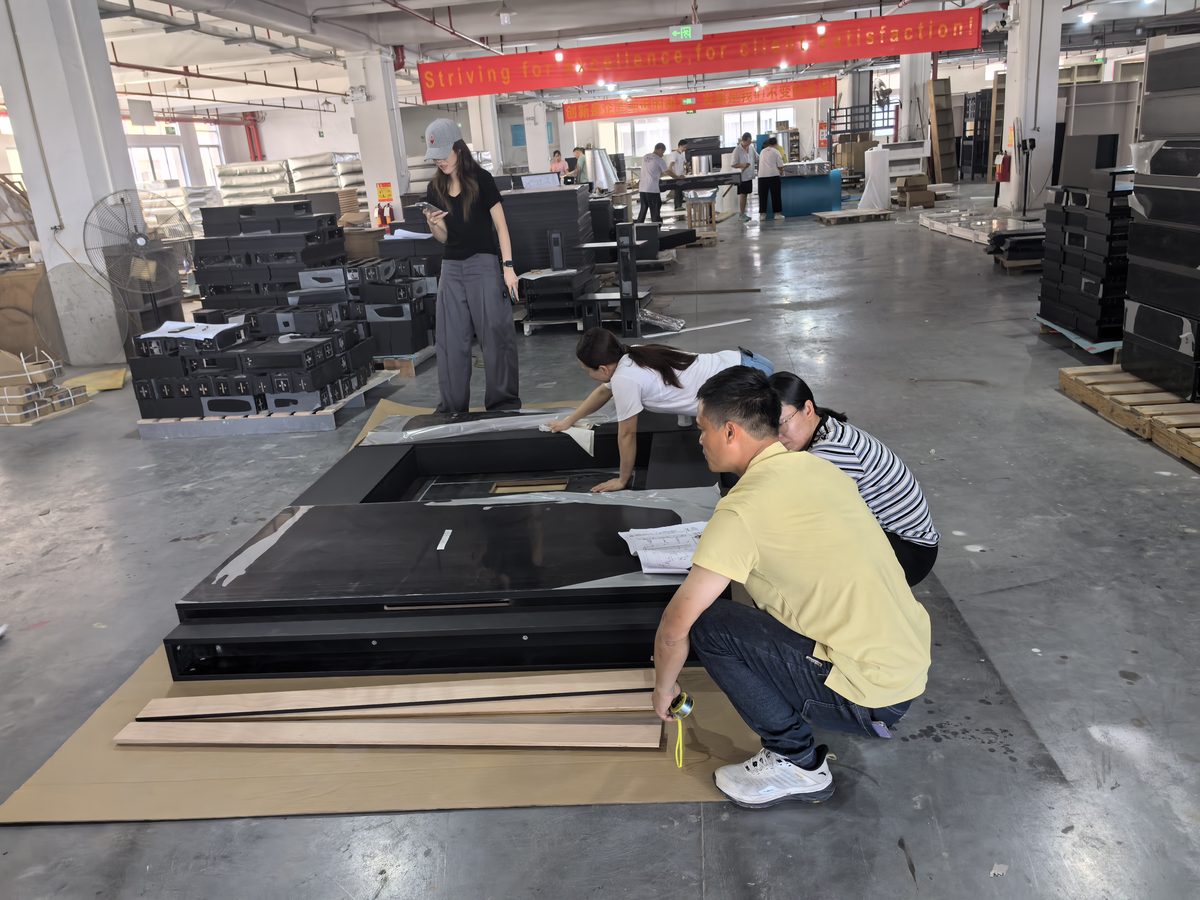
Hotel furniture production floor in Foshan with panels checked against an approved sample board before assembly
Production floor in our Foshan partner network. Panels are checked against the approved sample board before assembly, not after packing.
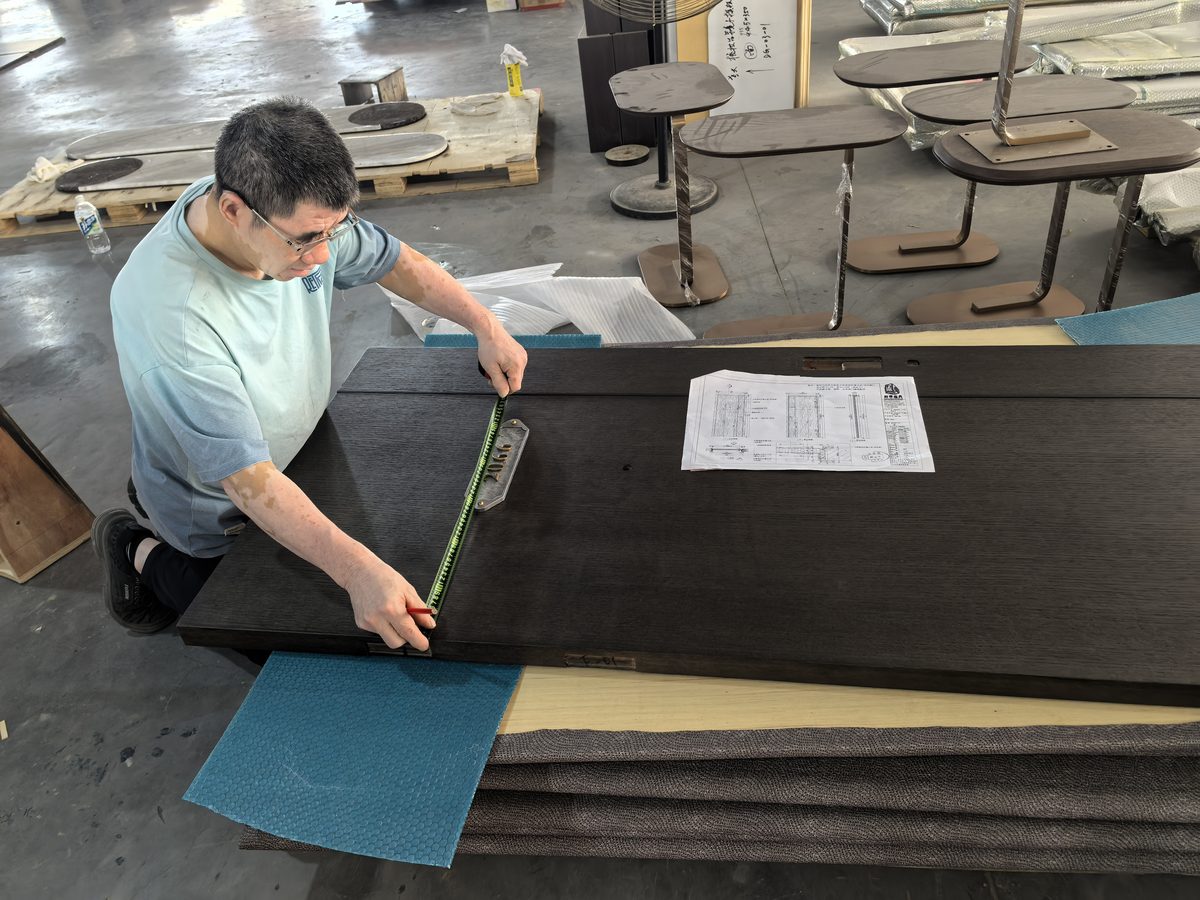
Inspector measuring a hotel furniture component against the shop drawing during first-article inspection
Dimensional check against the shop drawing. Every item family gets a first-article inspection before the run continues.

Category detail sits on the service pages: hotel guestroom furniture, custom hotel millwork and quality control and inspection. The certificate side — which standard applies to which category, and who holds it — is on the quality and compliance page.

How FF&E Procurement Runs

Six stages, in this order. Skipping forward is what produces change orders during production.

1

Scope

Drawing set, room types, quantities and the opening date

2

Specify

Item schedule, finishes, compliance standards, sample board

3

Tender

Qualified factories, comparable quotes, FOB and landed cost

4

Sample

Prototypes, fire tests, mockup room, written approval

5

Produce

First-article and mid-production inspection, weekly photo reports

6

Deliver

Pre-shipment inspection, consolidation, installation, warranty

Stage two is where most projects lose money. A finish that is not frozen before the quotation stage becomes a variation once the factory has bought material. The hotel FF&E checklist breaks each stage into the items to check and sign them off.

The Six Stages in Detail

Each stage has one owner, one document that closes it, and one failure mode if it is skipped. Most change orders on hotel packages trace back to a stage that was closed verbally.

Stage Owner What closes the stage Typical duration If it is skipped
1. Scope Owner, designer and procurement lead A signed drawing set with room types, counts and opening date 2–4 weeks Quantities are re-cut after tender and the price moves
2. Specify Interior designer A frozen finish schedule, item specification and the compliance standard for the destination market 3–6 weeks A finish change after material is bought becomes a variation
3. Tender Procurement lead Like-for-like quotes with FOB, packing and landed cost stated separately 2–3 weeks Two quotes look comparable and are not
4. Sample Integrator or factory An approved prototype, test reports and a written sign-off 7–10 days per item family The wrong finish is produced across every room
5. Produce Factory, monitored by QC First-article and mid-production inspection reports 10–14 weeks for a full package, FOB Defects are found on site, after the freight is paid
6. Deliver Integrator and freight forwarder Pre-shipment inspection, consolidation, documents and installation sign-off 25–40 days ocean transit Storage charges and a missed installation window

Durations assume a 150–300 room renovation with the design frozen at tender. A new-build with a full mockup room runs longer, and items with specialty finishes add 14–18 weeks of production. Transit is 25–30 days to Gulf ports and 30–40 days to Europe and the US East Coast.

The Roles in FF&E Procurement

On a well-run project each role has one job, and the handover points between them are written down. Where two parties assume the other has covered something, the gap shows up at installation.

Whether the party delivering the package is a trading company, a factory, an integrator or a buying group changes which of those roles it can actually carry. The four models are compared side by side in how to vet hotel FF&E suppliers.

Role What They Own Where the Risk Sits
Owner / developer Budget, opening date, and approval of the specification and the purchase order Late design changes and a compressed installation window
Interior designer The design intent, the finish schedule and the item specification Specifying finishes that cannot be produced to the standard required at the target cost
Procurement agent or consultant Tender management, price comparison and contract administration on the owner's behalf Managing the paperwork without owning the production outcome
FF&E integrator The package as delivered: factory allocation, sampling, quality control, consolidation, warranty Carries the delivery risk across every category on one purchase order
Partner factories Production to the frozen specification, and the test reports that go with it Material substitution and finish drift between sample and production
Freight forwarder Booking, documentation, customs clearance and transit Duty and classification errors, plus transit damage from packing choices made earlier
Brand technical services Confirmation that the specification meets the flag standard Approval arriving late and forcing a specification change

FF&E Procurement Is Not General Purchasing

Buying office furniture is a purchasing exercise. Buying a hotel FF&E package is a delivery exercise, and the difference shows up in five places.

FF&E vs OS&E vs MEP: Where the Line Falls

Four packages run on one hotel project. They are bought by different people, on different schedules, against different budgets — and the two that get confused are always FF&E and OS&E.

Package What it covers Who buys it When it is tendered
Construction Structure, envelope, wet trades, doors and ironmongery to the room Main contractor With the building contract
MEP Mechanical, electrical, plumbing, HVAC, fire fighting, lifts MEP contractor With the building contract, before FF&E
FF&E Loose and fitted furniture, decorative lighting, drapery, mirrors, fixtures Owner, through an FF&E contract 4–5 months before opening
OS&E Linen, tableware, glassware, housekeeping, kitchen smallwares, IT, back-of-house Operator, on a separate OS&E schedule 3–4 months before opening

The practical test: if the item is specified by the interior designer and installed by the fit-out contractor, it is FF&E. If the operator needs it to trade on day one but the designer never drew it, it is OS&E.

Dimension General purchasing Hotel FF&E procurement
Specification Catalogue items with fixed dimensions and finishes Project-specific items, drawn to the room layout and finish schedule
Compliance Supplier declaration is usually enough Test reports per fabric and foam build, per market standard
Timing Order to stock, any time Sequenced against construction, installation and the opening date
Volume and logistics Cartons to a warehouse 15–25 containers for a 300-room package, loaded in one window
Accountability Per order Across categories, on one purchase order, through to warranty

Five Things Buyers Get Wrong

Who Holds the Procurement Role

There are three common arrangements. Each puts the coordination work somewhere different.

Model How It Works What It Costs the Owner
Owner-managed The owner's team runs the tender and issues separate purchase orders per category Staff time, plus a partial-container and multiple-shipment freight penalty
Procurement agent A consultant tenders and administers the contracts, with a fee on top of the FF&E budget A visible fee, with production risk still sitting with the individual suppliers
Integrator One supplier of record takes the drawing set and delivers the whole package on one purchase order No separate procurement fee; margin sits inside the FOB unit price

foshanFFE works as an integrator. Guestroom and public-area packages are delivered on one purchase order through a 19-factory partner network in Foshan covering casegoods, soft seating, lobby furniture, lighting, mattresses, drapery, bath vanities and custom millwork. Standard production runs 6–8 weeks, and a full package runs 10–14 weeks before ocean transit.

The sequence behind that delivery is set out in the hotel furniture procurement guide, and the buyer-side comparison of supply models is on the FF&E procurement companies page. The coordination role itself is covered in why project management matters in FF&E procurement.

The function behind that sequence, split into specification, commercial, quality and logistics with an owner for each, is mapped on the FF&E procurement hub.

Frequently Asked Questions

It means buying and delivering everything a hotel needs to furnish its rooms and public areas, from the design specification to the installed item. FF&E stands for furniture, fixtures and equipment: casegoods, seating, lighting, mattresses, drapery, bath vanities and mirrors. Procurement covers that whole sequence: specification, tender, sampling, production, inspection, shipping and installation.

No. Purchasing is one transaction at a fixed price. Procurement covers the decisions and checks around that transaction: which standard applies in the destination market, which factory can produce the finish, whether the sample matches the approved board, whether the container loading matches the installation sequence. On a hotel package those checks decide whether the project opens on time, so the coordination work is the substance of the job.

The owner or developer carries the commercial responsibility. The interior designer owns the specification. Whoever is appointed to deliver the package owns the coordination: factory allocation, sampling, quality control, consolidation and warranty. On some projects that is the owner's own team, on others it is a procurement agent working for a fee, and on others it is an FF&E integrator delivering the whole package on one purchase order.

Construction builds the building: structure, MEP, tiling, ceilings, doors and the plumbing rough-in. FF&E procurement supplies what goes into it afterwards: furniture, lighting fixtures, drapery, mattresses, mirrors and vanities. The two run on parallel timelines and meet at installation, which is why the FF&E contract has to be locked four to five months before the opening date rather than after the contractor hands over.

From a frozen drawing set, standard production runs 6-8 weeks and a full package runs 10-14 weeks before ocean transit. Items with speciality finishes run 14-18 weeks. Sample approval adds 7–10 days per item family. Working back from the opening date, that means the FF&E contract should be locked four to five months ahead of opening.

Yes, and that is the integrator model. Casegoods, soft seating, lighting, mattresses, drapery, bath vanities and custom millwork come from different production methods, so an integrator coordinates a curated factory network instead of one factory trying to make everything. The buyer issues one purchase order, receives one compliance file and holds one warranty contact, and a 300-room package consolidates into 15-25 containers loaded within a five-day window.

Comparing delivery models for a live project? Send the scope, room count and destination market and the reply will set out how the package would be structured, or start from the FF&E sourcing FAQ.

Have a Scope That Needs a Procurement Route?

Send the drawing set, room types and destination market. The reply sets out how the package would be split across categories, what the FOB price per key looks like, and the lead time against your opening date.