Choosing a Partner

Best FF&E Procurement Companies:
How to Compare the Four Supply Models

A buyer's framework for filtering and comparing hospitality FF&E procurement partners

Start with the Framework

How to Compare FF&E Procurement Companies

There is no single best FF&E procurement company, because the four supply models do different jobs. A hospitality FF&E integrator, a procurement agent, a trading company and a direct manufacturer each carry the coordination risk in a different place. Match the model to the scope first, then compare the shortlist on category coverage, quality control, compliance documentation, logistics and single-point accountability.

Buyers searching for the best FF&E procurement companies usually start with a supplier list and a price comparison. That order is backwards. Two quotations for the same 300-room package can differ by 40% per key and both be honest, because they are pricing different scopes and different amounts of coordination.

The first filter is not the company. It is the delivery model. Each of the four models below places the coordination work somewhere different, and where that work sits decides lead time, cost structure and who answers when something arrives wrong.

Four Supply Models, Four Risk Positions

Read each model as a way of placing the coordination work. The work does not disappear in any of them; it either sits with one supplier of record or it moves onto the buyer's team.

Hospitality FF&E integrator

One supplier of record takes the drawing set and delivers the full guestroom and public-area package on one purchase order through a curated factory network. Casegoods, soft seating, lobby furniture, lighting, mattresses, drapery, bath vanities and custom millwork come from the production method each one needs, coordinated by one party. Fits multi-category packages and brand-standard projects where the buyer wants one warranty contact.

Procurement agent

A consultant runs the tender, compares quotations and administers the contracts on the owner's behalf, charging a fee on top of the FF&E budget. Percentage of budget, cost-plus and fixed fee are the common structures. Fits owners with in-house project management who want the fee visible as a separate line, and who are willing to hold production risk with the individual factories.

Trading company

An intermediary aggregates orders across a wide supplier network and adds a margin layer. Factory pricing is usually not visible to the buyer, and quality consistency depends on factories the buyer may never visit. Fits single-category or smaller orders where the buyer already has its own inspection arrangement.

Direct manufacturer

One factory produces the one or two categories its line is built for, to its own capability. Unit cost in that category is the lowest of the four models. Fits single-category scope, or a phased renovation where only casegoods or only upholstery is being replaced. The buyer becomes the integrator for everything else.

Model What It Costs the Owner Who Carries the Delivery Risk
Hospitality FF&E integrator No separate procurement fee. Margin sits inside the FOB unit price, so comparison happens at item level. The integrator, across every category, through to warranty.
Procurement agent A visible fee: commonly 8–15% of the FF&E budget, cost-plus, or a fixed fee per project or per key. The individual factories. The agent administers contracts rather than owning the production outcome.
Trading company Layered margins. The factory price is not disclosed, so the markup cannot be benchmarked. Split between the trader and factories the buyer did not select.
Direct manufacturer Lowest unit cost in that manufacturer's own category. The buyer, for every category the factory does not make.

The FF&E procurement fee structures are set out separately, including what a fee usually covers and what it usually excludes.

Which model fits depends less on budget than on scope. A new-build branded hotel usually needs an integrator, because the brand standard package, the designer's drawings and the operator's opening date all have to converge on one delivery schedule. A renovation that keeps existing casegoods but replaces soft goods and lighting often suits a procurement agent, since the remaining categories can be tendered separately without much coordination risk. A single-category refresh — mattresses, say, or outdoor furniture — is usually cleanest bought direct from the manufacturer. Multi-brand portfolios tend to split: one integrator for the full-package properties, direct manufacturers for the prototype-driven ones.

Six Dimensions to Evaluate

Once the model is settled, the shortlist can be compared on things that do not change with the model. These six dimensions separate a proposal that reads well from one that will deliver.

1. Project experience in the right segment

Ask for the segment and the scope actually delivered, not a client logo wall. A supplier who has delivered full guestroom and public-area packages for US and Middle East hotel projects is answering a different question from one who has supplied casegoods to a single property. Brand-standard experience matters where the specification has to be signed off by a flag's technical services team. Package references include a hotel FF&E project delivered for Hotel H2O Manila and a Dubai project completed on a 52-day expedited schedule.

2. Category coverage under one purchase order

List the categories and ask which ones sit inside the purchase order. A full package covers casegoods, soft seating, lobby furniture, lighting, mattresses, drapery, bath vanities and custom millwork. If three of those are handed back to the buyer to source separately, the quotation is for a smaller job than the scope, and the freight consolidation benefit goes with it. A 300-room package consolidates into 15–25 containers loaded in a single five-day window when one supplier coordinates it. The category-by-category version is on the FF&E package breakdown and the FF&E items list.

3. Quality control and inspection

Ask what is inspected, when, and who signs the report. The workable standard is three stages: incoming material inspection, in-process checks before finishing, and a pre-shipment audit against the approved mock-up room. Pre-shipment inspection should sit inside the scope rather than being an optional extra. Reports should be issued per container with photo documentation, and consolidated into one file per purchase order. The stage-by-stage version is on the hotel FF&E procurement checklist.

4. Compliance and certification documentation

Compliance is where an under-specified proposal becomes the owner's problem. Ask which standards the test reports will reference for the destination market: CAL TB 117-2013 for US upholstery, BS 7176 for UK and GCC projects, EN 1021 for Europe, NFPA 701 for drapery, CARB Phase 2 for composite wood, and UL where electrical components are involved. Test reports are per fabric and per foam build, not per supplier, so a package carrying many fabrics needs more testing documentation than one built on a tighter palette.

5. Logistics, consolidation and customs

Ask how many containers the package loads into and in what window, who books the freight and who prepares the export documents. The documents that most often hold up a hotel FF&E shipment are the commercial invoice and packing list, the certificate of origin, the ISPM 15 fumigation certificate for wood packaging and the bill of lading. A supplier who cannot describe consolidation planning is passing the coordination to the buyer's freight forwarder.

6. A single point of accountability

The last dimension is the shortest to check and the most expensive to get wrong. Ask who is named on the purchase order, who owns the warranty claim after handover, and what happens when one category is late. Under the integrator model the answer is one party, from drawing to container. Under every other model it is the buyer. The comparison is in integrator vs. manufacturer vs. trading company.
Who Is Behind This Comparison

This framework was assembled from fifteen years of on-the-ground procurement across 19 Foshan partner factories, not from a desk in a different time zone. The four models, six dimensions, and eight red flags below were extracted from real engagements — the kind where a sample arrives late, a container gets repacked, or a drawing dimension drifts 3 mm on a 2.4-m conference table.

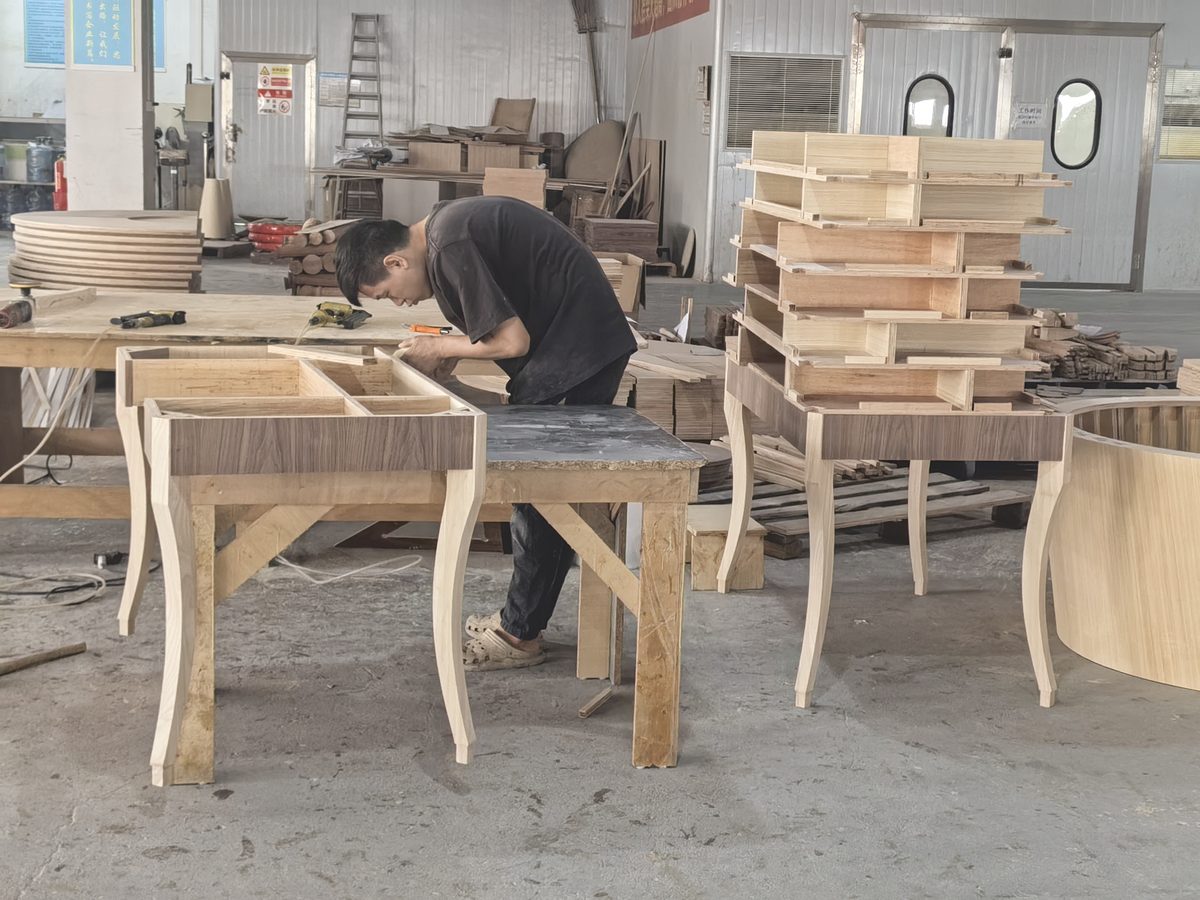
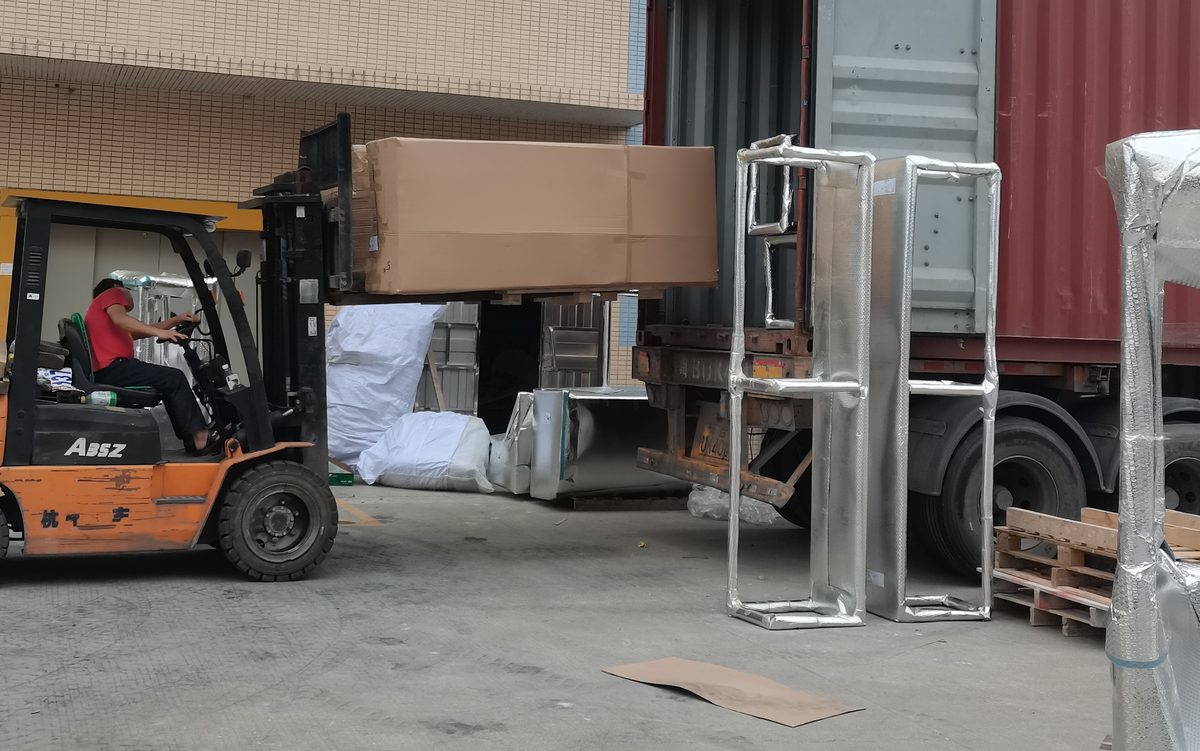
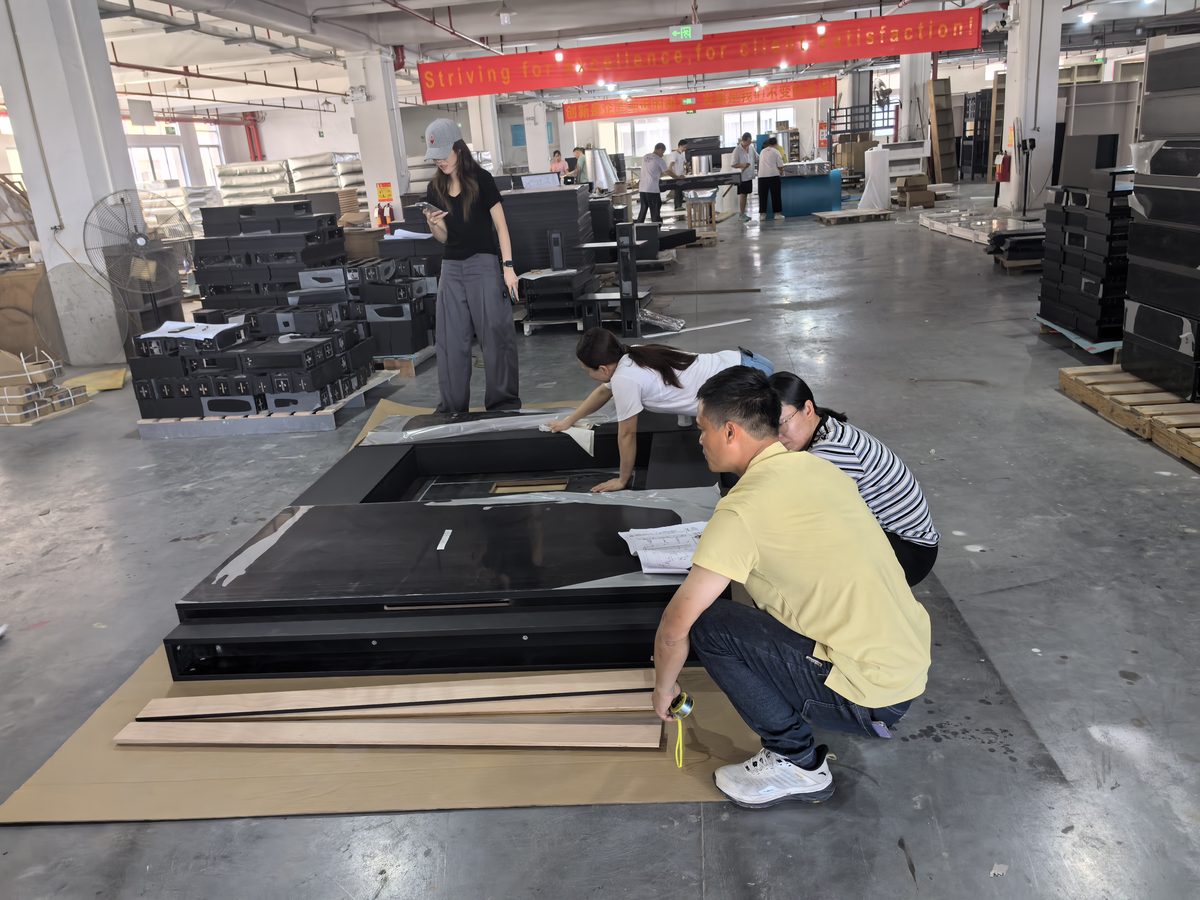
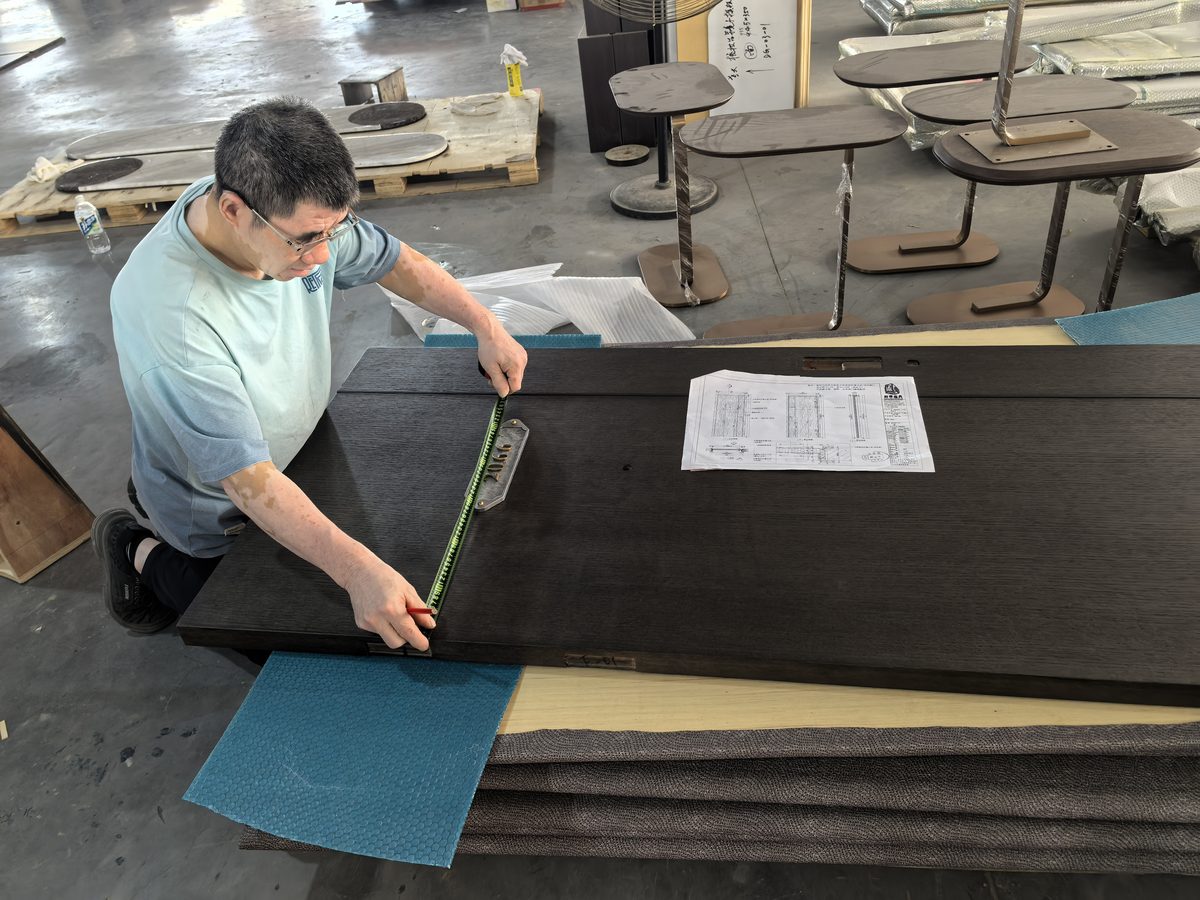
QC inspection on hotel furniture production floor Measuring casegoods against approved shop drawing Nightstand assembly line for hotel FF&E project Container loading with forklift at Foshan factory
19
Foshan partner factories under one PO
41
Factory-floor photographs verifiable on this site
25–30
Days from approved sample to production start
100%
Single supplier-of-record accountability

Eight Warning Signs in a Proposal

How to Run the Comparison

A shortlist of three suppliers is enough. The work is in making the answers comparable.

1

Freeze the scope

Drawing set, room types, quantities and destination market written down before any quotation is requested.

2

Set the model

Decide which of the four supply models the project needs, then shortlist only within it.

3

Compare item by item

Same dimensions, same finish, same foam and fabric build, same test documentation, same packing.

4

Check the handover points

Who inspects, who consolidates, who clears customs, who owns the warranty claim after handover.

The stage sequence behind these steps is in the hotel furniture procurement guide, and the role each party owns is in what FF&E procurement covers. Step four is where shortlists are won or lost: how to vet FF&E suppliers sets out the six checks and the three factory verification steps behind them. Which of the four workstreams your comparison is actually solving for is laid out on the FF&E procurement hub.

Twelve Questions to Put to Any Supplier

Send the same twelve questions to every supplier. The answers are comparable; sales material is not.

  1. Which categories are inside the purchase order, and which would be handed back to us?
  2. Is the price itemised so it can be compared line by line with another quotation?
  3. What does the quoted price exclude?
  4. Is pre-shipment inspection inside the scope, and what AQL level applies?
  5. Which test reports come with the package, and to which standards?
  6. Is the lead time quoted from a frozen drawing set or from today's date?
  7. How many containers will the package load into, and in what window?
  8. Who books the freight and prepares the export documents?
  9. What is the process if a factory wants to substitute a material mid-production?
  10. Who owns the warranty claim after handover?
  11. Who is the named contact when a milestone slips?
  12. What does the mock-up room approval process look like, and who signs it off?

Question six is the one most often answered loosely. A lead time quoted before the finish schedule is frozen is a forecast, not a commitment; the sequence is on why project management matters in FF&E procurement.

Frequently Asked Questions

Start with the delivery model rather than a supplier list. Decide whether the project needs a hospitality FF&E integrator, a procurement agent, a trading company or a direct manufacturer, because each carries the coordination risk in a different place. Then compare the shortlist on project experience, category coverage, quality control, compliance documentation, logistics and single-point accountability.

A procurement agent tenders the package and administers the contracts for a fee, but production risk stays with the individual factories. An integrator takes the drawing set and delivers the whole package on one purchase order, with no separate procurement fee and the margin inside the FOB unit price, so delivery risk across every category sits with one supplier of record.

No. The structure matters more than the rate. A low percentage applied to a budget that includes items the agent will not actually buy is not a low fee, and a fixed fee that excludes inspection and freight coordination is not fixed. Read what the fee covers, then read the number.

Yes, under the integrator model. Casegoods, soft seating, lobby furniture, lighting, mattresses, drapery, bath vanities and custom millwork come from different production methods, so one supplier of record coordinates a factory network rather than one factory making everything. A 300-room package consolidates into 15-25 containers loaded within a five-day window.

Documentation against the standards the destination market requires, gathered into one compliance file per purchase order. In practice that means CAL TB 117-2013 for US upholstery, BS 7176 for UK and GCC projects, EN 1021 for Europe, NFPA 701 for drapery, CARB Phase 2 for composite wood, and UL where electrical components are specified.

Standard production runs 6-8 weeks, and a full package runs 10-14 weeks from frozen drawings to container loading. Items with specialty finishes run 14-18 weeks. Sampling and approval add two to three weeks each, which is why the FF&E contract should be locked four to five months before the opening date.

Only if the scope is genuinely single-category or phased. Splitting a full package across suppliers usually costs the freight consolidation benefit and creates handover gaps between categories. A package assembled from five suppliers arrives in five partial shipments, with five specification standards and no single party accountable when an item is wrong.

Comparing models for a live project? Send the room count, category scope and destination market — the reply sets out how the package would be structured, what the FOB price per key looks like, and the lead time against the opening date. Cost benchmarks by star rating are on the FF&E cost per key page.

Most FF&E procurement companies charge between 5% and 15% of the total order value as a sourcing or management fee, though the exact percentage depends on scope, complexity, and whether the fee is bundled into product pricing. Some integrators work on a fixed-per-SKU basis for repeat projects; others quote a flat project management fee once the room count and opening date are set. The key question to ask is whether the fee is transparent and whether the supplier has financial accountability for quality — a 5% fee with a single supplier-of-record who stands behind defects usually costs less over the life of a project than a 3% fee with no recourse.

An FF&E procurement company coordinates the entire supply chain for hotel furniture, fixtures and equipment — from interpreting interior design drawings and sourcing materials, to managing production across multiple factories, running QC inspections against approved samples, packing to container-optimization plans, handling export documentation, and overseeing on-site installation at the project location. The integrator model adds a single point of accountability: one PO, one supplier-of-record, one responsible party if a dimension drifts or a container arrives short. The difference between an integrator and a traditional trading company is whether the procurement partner has direct access to the production floor and can send QC staff to verify output against the drawing — not just rely on supplier-provided photos.

For a full guestroom and public-area package of 50–200 keys, the typical timeline runs 10–14 weeks from design approval to container loading: 15–20 days for sampling, 10–15 days for sample revision and approval, 42–56 days for bulk production, and 7–14 days for QC, packing and export clearance. The single biggest variable is the sample approval loop — projects that approve the first sample without revision can start production two weeks earlier than projects that go through three revision rounds. The second biggest variable is whether the procurement partner consolidates all categories (casegoods, upholstery, drapery, lighting, mattress, bath vanities) under one PO, which eliminates the coordination overhead of managing six different suppliers and their respective shipping schedules.

Compare the Models on Your Scope

Send the room count, category scope and destination market. The reply sets out how the package would be structured, what the FOB price per key looks like, and the lead time against your opening date.