Supplier Due Diligence

FF&E Suppliers:
How to Vet, Compare and Choose the Right Partner

Most hotel FF&E problems are not design problems. They are supplier selection problems that surface eighteen months later as a short container, a drifted dimension, or a warranty nobody honours. This guide gives you the four supplier types, six due-diligence dimensions, three ways to verify a factory, and twelve questions worth asking before you sign. For the plant visit itself, the Foshan furniture factory guide covers what to look for on the floor and in the export record.

What an FF&E Supplier Actually Is

An FF&E supplier is the company that manufactures or sources furniture, fixtures and equipment for a hotel and delivers it to site. There are four types: trading companies, factory-direct manufacturers, integrators, and buying groups. They differ less in what they can quote than in who carries accountability when a container arrives wrong.

The right type depends on three variables. How many categories your scope covers. Whether the design intent requires custom production or can absorb a catalogue item. And whether your opening date can survive a multi-vendor coordination failure. A 60-key boutique renovation and a 400-key resort under a brand PIP are not the same purchasing problem, and a supplier that fits one will usually fail the other.

Four Types of FF&E Suppliers, Four Accountability Models

The label on the business card matters less than where the risk sits. Read each row as: if this goes wrong, who is contractually and financially on the hook.

Supplier Type Typical Scope Who Owns the Risk Price Transparency Fits Best When
Trading Company Any category, sourced from whichever factory quotes lowest You do. The trader passes factory terms through and rarely carries warranty exposure beyond the factory's own. Low. Margin is buried in unit price and rarely disclosed as a line item. Scope is narrow, design is catalogue-based, and you have your own QC team on the ground.
Factory-Direct Manufacturer One or two categories they actually produce The factory does, but only inside its own four walls. Anything outside that category is subcontracted or refused. High. You are buying from the cost centre, so unit economics are visible. Scope is a single category, volume justifies a dedicated line, and you can manage the other categories separately.
Integrator Full guestroom and public-area packages across many categories, one PO The integrator does, across every category in the package, including ones it does not manufacture. Medium to high. Fee structure is disclosed separately from product cost. Scope spans multiple categories, opening date is fixed, and you do not want to run six supplier relationships.
Buying Group / GPO Pre-negotiated catalogue across member brands The group does on price, the member supplier does on quality. The split is where disputes start. Medium. Group pricing is transparent, but the member supplier's execution is not. You are a branded property bound to a group agreement and your scope fits the catalogue.
01

Trading Companies Win on Flexibility, Lose on Recourse

A trader will quote almost anything because they are not carrying inventory or tooling. That flexibility is real value when your scope is small and your specs are loose. It becomes a liability when a dimension drifts, because the trader's answer is usually "the factory made it to their standard." You have no contract with the factory, so there is no second door to knock on.

02

Factory-Direct Wins on Cost, Loses on Coverage

Buying from the factory that makes the product removes one margin layer, and you can usually walk the line. The constraint is that a casegoods factory does not make drapery, and a lighting factory does not make mattresses. If your package spans eight categories, factory-direct means eight relationships, eight shipping schedules, and eight sets of documents arriving at a port at different times.

03

Integrators Win on Accountability, Cost a Fee

An integrator consolidates production across a partner network and takes the contract for the whole package. You get one PO, one schedule, one set of export documents, and one party responsible when something is short. You pay for that coordination. The question is not whether the fee is worth it, but whether the coordination failure it prevents would have cost more.

04

Buying Groups Win on Price, Split on Execution

Group purchasing organisations negotiate rates across member brands. The pricing is real and often better than a single property can achieve alone. The gap is execution. The group negotiates, the member supplier delivers, and when a delivery goes wrong the group points at the member while the member points at the group's spec.

Six Dimensions That Actually Predict Supplier Performance

Most supplier scorecards measure the wrong things. Catalogue size, years in business, and number of countries served are easy to present and weakly correlated with whether your container arrives correct. These six are harder to fake.

1

Factory Access

Ask for a live video walkthrough of the production line, scheduled at a time you choose, with no advance notice of which line. A supplier with real factory access can do this within a day. A trader will offer a pre-recorded video, a showroom tour, or a "factory partner" who is conveniently unavailable. The difference between those two responses is the single most useful signal in the entire evaluation.

What good looks like: live call, camera moves freely, workers visible, you can ask them to zoom into a specific joint or finish.

2

Drawing-to-Production Discipline

Custom hotel furniture is a translation problem. The designer's drawing becomes a shop drawing, the shop drawing becomes a cutting list, and the cutting list becomes the object on the floor. Every handoff loses precision. Ask how many approval gates exist between the designer's drawing and the first cut, and who signs at each one. A supplier that answers "we work from the drawing" has no gates.

What good looks like: at least three sign-off points, with a named person at each, and a documented dimension check before cutting.

3

QC Ownership

The question is not whether the supplier does quality control. Everyone says yes. The question is who pays for the rework when QC fails. If the answer is "the factory," then QC is a suggestion. If the answer is "we do, out of our margin," then QC is a cost centre the supplier is motivated to run properly. Ask directly: show me a project where you ate the rework cost.

What good looks like: a specific example with a number, and a warranty clause that does not route the claim back to the factory.

4

Category Depth Versus Breadth

A supplier that claims twelve categories usually has real depth in three and sources the rest. That is not automatically bad, but you need to know which is which before you assign responsibility. Ask them to name the categories where they own the production line, and the categories where they are coordinating a partner. Then ask what changes about warranty and lead time in the second group.

What good looks like: a clear split, stated without hedging, and different warranty terms for each group.

5

Export and Logistics Competence

Manufacturing well and shipping well are different skills. Ask for the container loading plan for a recent project: how many cartons, what the CBM came to, whether they hit the planned utilisation, and what they did when they did not. A supplier that has never tracked container utilisation is loading by eye, and you are paying for the empty space.

What good looks like: a real loading plan with CBM, carton count, and a stated utilisation percentage.

6

Financial and Warranty Standing

Ask for the legal entity name, the registered production address, and the certificate numbers for any ISO or product certification they claim. Then verify them independently. A supplier that hesitates on the legal entity name is a supplier whose warranty you will not be able to enforce, because you will not know who to enforce it against.

What good looks like: legal name, address and certificate numbers provided in writing within one business day.

Three Ways to Confirm a Supplier Actually Runs a Factory

Roughly half the companies presenting as FF&E manufacturers in Foshan are sourcing agents with a showroom. That is not a scandal, and it is not always a problem, but you should know which one you are buying from before you wire a deposit.

1. Request a live, unscheduled walkthrough

Pick a time inside their working hours and ask for a video call on the production floor. Do not accept a recording. Do not accept a showroom. If they need two days to arrange it, that tells you something. If they cannot do it at all, that tells you everything.

2. Cross-check the registered address

Ask for the business licence and the production address, then compare them against the address on their website and their export documents. Mismatches are common and usually innocent, but a persistent mismatch across three sources means the entity you are contracting with is not the entity making the product.

3. Ask for dated QC photos from a live order

Request QC images from an order currently in production, with the date visible in the metadata or on a card in frame. Photos from a finished project prove nothing, because finished projects can be photographed anywhere. An order in progress is much harder to fake.

A visit does the same job in person. What a buyer can actually verify on the floor — panel processing, CNC machining, multi-bore drilling, the QC stations and the finishing lines — is walked through in inside a partner Foshan factory.

Who Is Behind This Guide

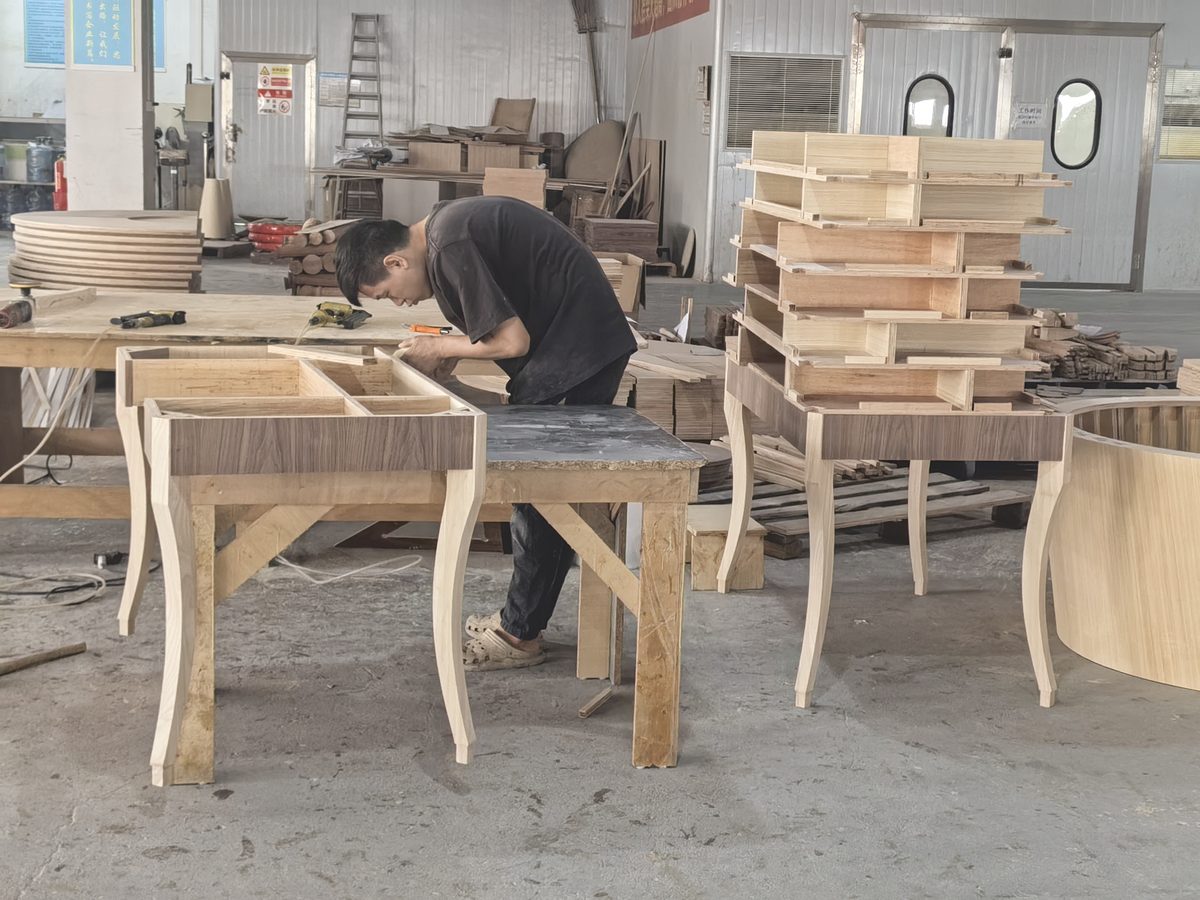
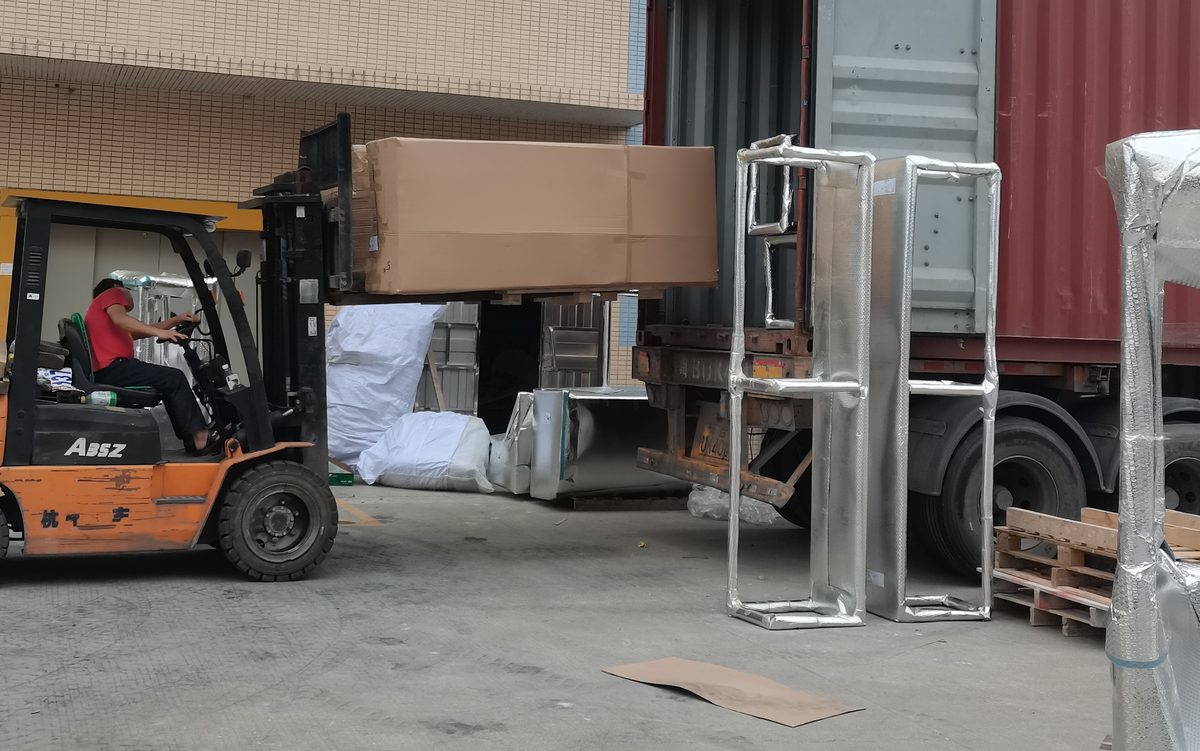
These six dimensions come from running packages through the Foshan production base rather than from a desk elsewhere. The photographs below are from partner factory floors, taken during live orders. They are here so you can see what the verification standard in this guide actually looks like, not as decoration.
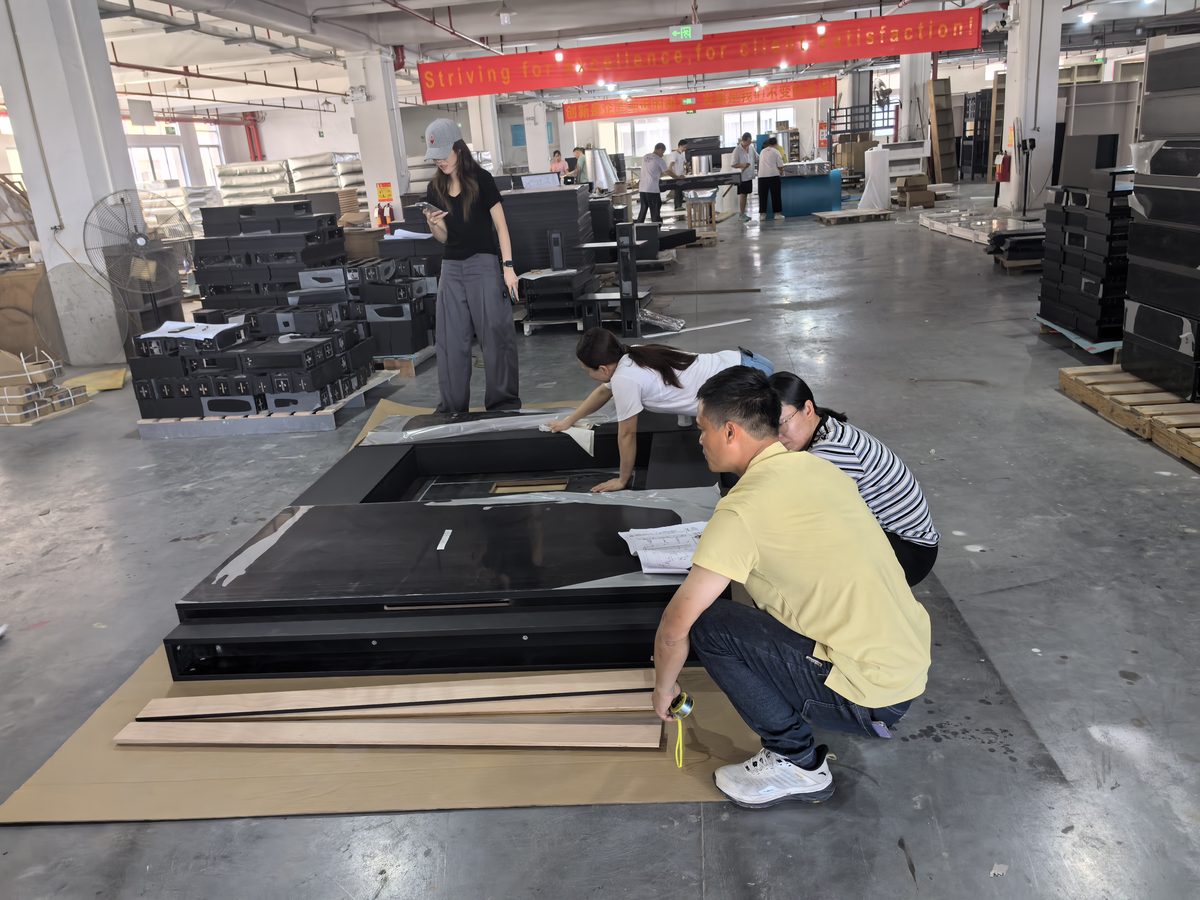
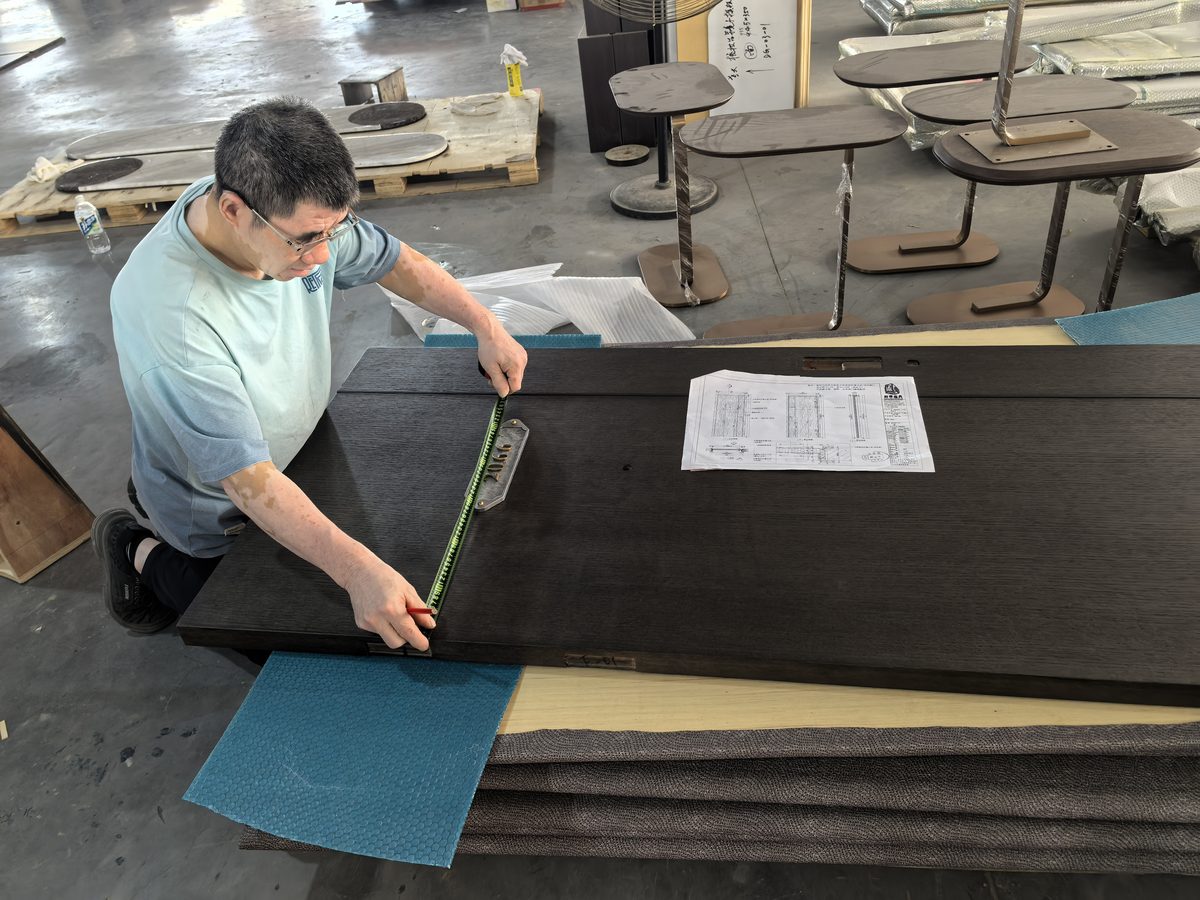
QC inspection on hotel furniture production floor in Foshan Measuring hotel casegoods against approved shop drawing Nightstand assembly line for a hotel FF&E order Container loading with forklift at Foshan furniture factory
19
Foshan partner factories under one PO
41
Factory-floor photographs on this site
25–30
Days from approved sample to production start
100%
Single supplier-of-record accountability

Vetting is one of four workstreams inside an FF&E package. The other three, and where each one usually fails, are mapped on the FF&E procurement hub. The scope all four sit inside is defined on what FF&E procurement covers.

Three Fee Structures, Three Different Risks

How a supplier charges tells you what they are optimising for. A percentage fee optimises for order value. A fixed fee optimises for scope control. A bundled price optimises for margin opacity. None is dishonest, but only one of them lets you compare quotes properly.

%

Percentage of Order Value

Typical range: 5% to 15%. The fee is quoted as a percentage of the total package value and shown as a separate line. This structure is easy to compare across suppliers because the product cost and the service cost are separated. The risk is incentive alignment: a percentage fee rises with order value, so there is no built-in pressure to value-engineer your spec down.

Ask: Is the percentage applied to the FOB value or the delivered value? Is it flat across categories, or does it vary where you are coordinating a partner rather than producing in-house?

≡

Fixed Project Fee

Typical range: quoted per project, scaled to room count and category count. A flat fee is agreed once scope is fixed. This structure favours the buyer when scope is well defined, because the supplier absorbs the cost of scope creep. It favours the supplier when scope is vague, because they will price in a buffer for the ambiguity.

Ask: What counts as a scope change? At what point does a revision become billable? Get this in writing before you sign, because the answer determines whether the fixed fee stays fixed.

×

Bundled Into Unit Price

Typical range: invisible. No fee line appears. The supplier's margin is embedded in the per-unit price. This is the most common structure among trading companies and the hardest to compare, because two quotes for the same chair can differ by 30% with no way to see whether the gap is product cost, service cost, or margin.

Ask: Can you break this quote into product cost and service cost? A supplier that refuses is not necessarily overcharging, but they are removing your ability to check.

Twelve Questions Worth Asking Before You Sign

Each question below has a purpose beyond the answer. What you are listening for is whether the supplier has been asked this before, and whether the answer comes with a specific example or a general assurance.

  1. 01 Which categories do you produce in-house, and which do you coordinate through partners? You are testing whether they know the difference, and whether they will say it out loud. A supplier that claims everything in-house either has an unusually wide factory or is not being straight with you.
  2. 02 Can we do a live video walkthrough of the line producing our category? Not a recording, not a showroom. Live, at a time you choose. This is the fastest filter in the list.
  3. 03 How many approval gates sit between the designer's drawing and the first cut? Fewer than three means dimensions will drift. Ask who signs at each gate and what happens when a gate is skipped under schedule pressure.
  4. 04 Show me a project where you absorbed the rework cost yourself. If every QC failure has been billed back to the factory, QC is decorative. A supplier that has never eaten a rework cost has either never had a failure or never owned one.
  5. 05 What was your container utilisation on the last three shipments? A supplier that tracks CBM can answer immediately. One that does not is loading by eye, and you are paying for the air.
  6. 06 What is your legal entity name and registered production address? You need this to enforce a warranty. A supplier that deflects the question is telling you the warranty will be hard to claim.
  7. 07 What is your sample-to-production lead time, and what causes it to slip? Ask for the range, not the best case. Then ask what the most common cause of slippage was on the last ten projects.
  8. 08 Which certifications do you hold, and what are the certificate numbers? ISO 9001, ISO 14001, ISO 45001 and product certifications are all verifiable. Ask for numbers, not logos.
  9. 09 Who handles installation, and are they your people or a local contractor? If installation is a local contractor, ask who owns the defect liability when a piece is damaged during install. The answer is usually "you do," and it should be priced in.
  10. 10 What are your payment terms, and what triggers each milestone? Standard terms run deposit, pre-shipment, and balance on documents. Ask what specifically triggers the pre-shipment release, and who signs off.
  11. 11 What is your warranty period, and what does it exclude? Two years is common for hotel FF&E. The exclusions matter more than the period. Natural material movement, humidity damage, and installation damage are usually excluded, and those are the three most likely failure modes.
  12. 12 If your main factory fails, what is your contingency? This question separates a supplier with a network from a supplier with one relationship. Listen for a specific alternative and a stated switchover time.

FF&E Supplier Questions, Answered Directly

An FF&E supplier makes or sources the product and delivers it. An FF&E procurement company manages the buying process on your behalf: specification review, supplier selection, order placement, QC oversight, and delivery coordination. Many companies do both, which is why the terms get used interchangeably. The distinction matters when something goes wrong, because the party that signed the purchase contract is the one with legal standing to claim against the factory, and that is not always the party you hired.

Three checks, in order of speed. First, request a live unscheduled video walkthrough of the production floor; a real manufacturer can do this within a day, a sourcing agent cannot. Second, ask for the business licence and compare the registered production address against the website and export documents; persistent mismatches mean the contracting entity is not the manufacturing entity. Third, request dated QC photographs from an order currently in production, not from a completed project. Completed projects can be photographed anywhere; work in progress cannot.

A comparable quote should show, per SKU: unit price, quantity, material specification, finish, dimensions, CBM per unit, and lead time. At package level it should show total CBM, container count, Incoterm, and the fee structure broken out separately from product cost. Quotes that show only unit price and a total cannot be compared, because you cannot see whether the gap between two suppliers is product cost, service cost, or margin. Ask for the breakdown before you compare anything.

Some do, most do not, and the ones that do usually subcontract to a local installer at destination. What matters is who carries defect liability during installation. If a piece is damaged in transit or during install, the claim chain runs from the installer to the supplier to the factory, and each handoff is an opportunity for the claim to be declined. Ask specifically: if a casegood is damaged during installation, who pays for the replacement, and how long does the replacement take to arrive. Get the answer in writing.

Standard terms are 30% deposit on order, 60% before shipment against QC report and packing list, and 10% balance against shipping documents. Some suppliers ask for 50/50, which shifts more risk to you before you have seen the goods. Terms tighter than 30/60/10 usually indicate either a cash-constrained supplier or a supplier that has been burned by a buyer, and both are worth understanding before you agree. Never accept terms where the pre-shipment release is triggered by a date rather than by a QC sign-off.

For a multi-category hotel package, plan 10-14 weeks from design approval to container loading. That breaks down as roughly 15 to 20 days for sampling, 10 to 15 days for sample revision and approval, 25 to 30 days for bulk production, and 15 to 20 days for QC, packing and export clearance. Then add ocean transit. The single biggest variable is the sample approval loop: a project that approves the first sample starts production two weeks earlier than one that runs three revision rounds.

Only if that supplier is an integrator with a partner network, because no single factory produces casegoods, upholstery, drapery, lighting, mattresses, and bath vanities under one roof. A factory-direct supplier will cover guestroom casegoods well and then either decline the public-area scope or subcontract it without telling you. The practical test is to ask which categories are in-house and which are coordinated, then ask what changes about warranty and lead time for the second group.

At minimum, ISO 9001 for quality management, and for most hotel projects ISO 14001 and ISO 45001 as well. Beyond that, it depends on your market and brand. US-bound projects usually need CARB Phase 2 compliance for composite wood and UL listings for electrical components. Middle East projects often require fire performance documentation against BS 5852 or CAL TB 117 depending on the brand standard. Ask for certificate numbers and verify them, because logos on a website prove nothing.

Three structures dominate. A percentage fee of 5% to 15% of order value, shown as a separate line. A fixed project fee scaled to room count and category count. Or a bundled price where the margin sits inside the unit cost and never appears. Percentage and fixed fees are comparable across suppliers because product cost and service cost are separated. Bundled pricing is not comparable, and a supplier that refuses to break it down is removing your ability to check the quote rather than protecting a trade secret.

Supplier-of-record is the single legal entity that signs the contract for the whole package and carries responsibility for every category in it, including the ones it does not manufacture. It is the difference between coordinating six suppliers yourself and holding one party accountable when a container arrives short. In practice it means one PO, one schedule, one set of export documents, and one party to claim against. The cost of that consolidation is a fee; the cost of not having it is the coordination overhead and the finger-pointing when something goes wrong.

Put Your Scope Against This Checklist

Send the category list, room count, brand standard and target opening date. You will get back a written assessment of which supplier type fits, what the realistic lead time is, and where the risk sits in your specific package.

FF&E Sourcing Notes